The AMDDL family @ Southeast Univeristy for public health and one health
Research
1. Isothermal Nucleic Acid Amplification and Biosensors
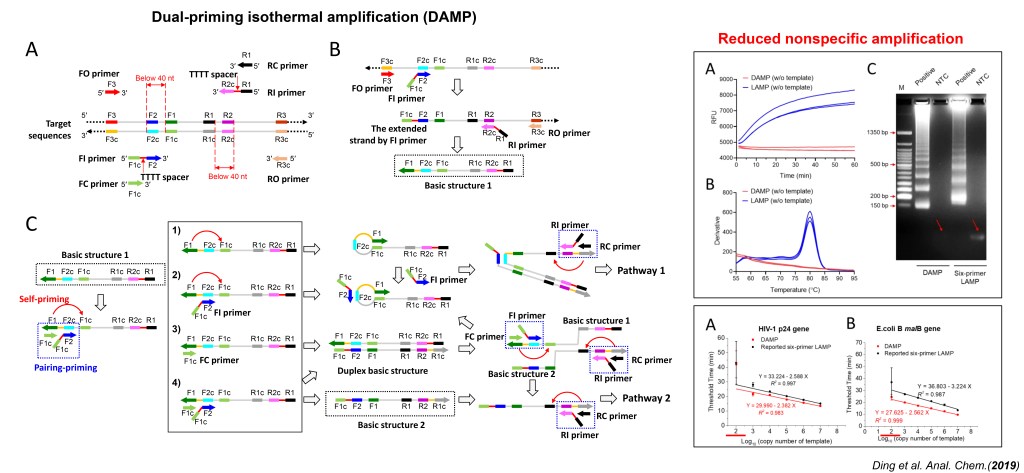
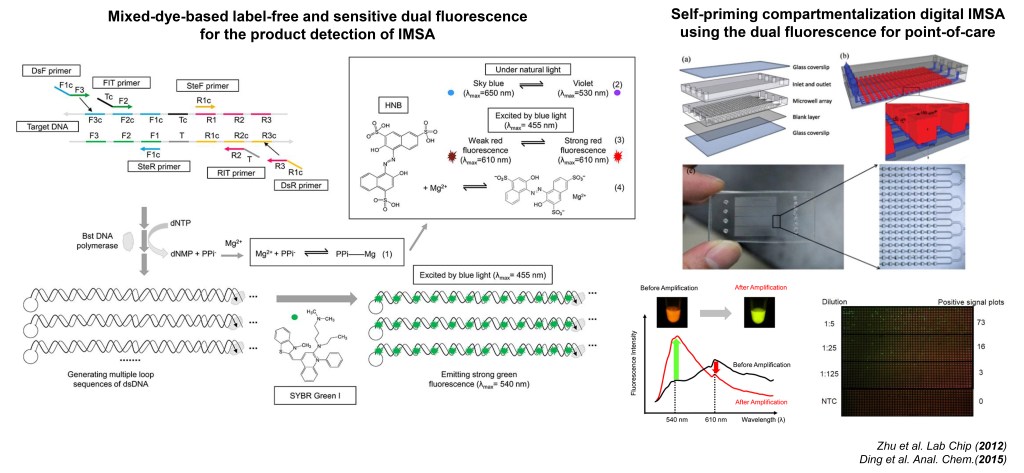
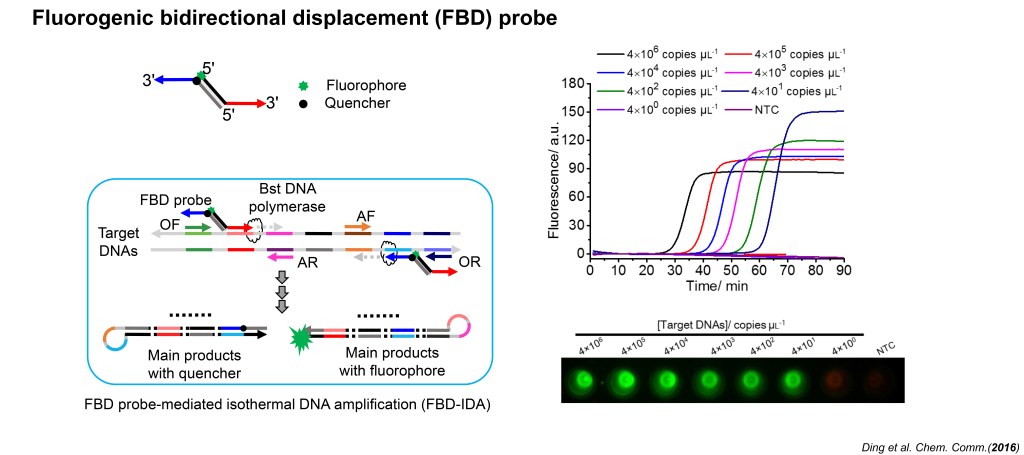
Isothermal amplification of nucleic acids has become a promising alternative to conventional polymerase chain reaction (PCR) towards point-of-care testing or rapid onsite diagnostics. We still have the challenges from this technology such as compromised diagnostic sensitivity and specificity, uncontrollable nonspecific amplification, and multiplexed detection. Through redesigning the principles, applying new nucleotide probes, and combining microfluidics, we are developing many new isothermal nucleic acid amplification methods and exploring new biosensing systems for the applications on pathogen identification, food safety monitoring, early cancer detection, and so on.
Xiong Ding, Kai Nie, Lei Shi, Yong Zhang, Li Guan, Dan Zhang, Shunxiang Qi*, Xuejun Ma*: Improved Detection Limit in Rapid Detection of Human Enterovirus 71 and Coxsackievirus A16 by a Novel Reverse Transcription-Isothermal Multiple-Self-Matching-Initiated Amplification Assay. Journal of Clinical Microbiology, 2014, 52(6), 1862-1870.Xiong Ding, Zhiheng Xu, Kun Yin, Maroun Sfeir, Changchun Liu*: Dual-Priming Isothermal Amplification (DAMP) for Highly Sensitive and Specific Molecular Detection with Ultralow Nonspecific Signals. Analytical chemistry, 2019, 91, 12852-12858.Xiong Ding, Wenshuai Wu, Qiangyuan Zhu, Tao Zhang, Wei Jin, Ying Mu*: Mixed-Dye-Based Label-Free and Sensitive Dual Fluorescence for the Product Detection of Nucleic Acid Isothermal Multiple-Self-Matching-Initiated Amplification. Analytical Chemistry, 2015, 87(20), 10306-10314.Xiong Ding, Guoping Wang, Jingjing Sun, Tao Zhang, Ying Mu*: Fluorogenic bidirectional displacement probe-based real-time isothermal DNA amplification and specific visual detection of products. Chemical Communications, 2016, 52, 11438-11441Xiong Ding, Kun Yin, Ju Chen, Kepeng Wang, Changchun Liu*: Ribonuclease-dependent cleavable beacon primer triggering DNA amplification for single nucleotide mutation detection with ultrahigh sensitivity and selectivity. Chemical Communications, 2019, 55, 12623-12626
2. Synthetic Biology (CRISPR-Cas) and Molecular Diagnostics
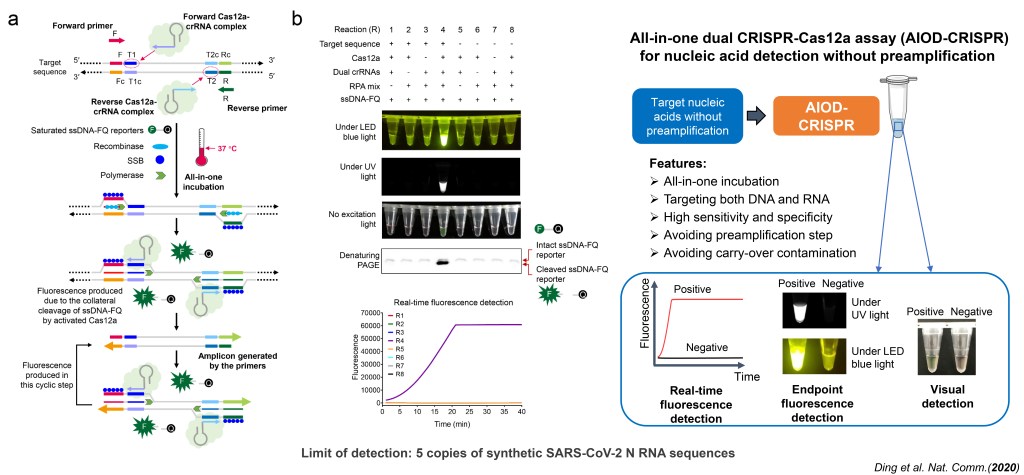
We mainly use the combination of isothermal amplification and CRISPR-Cas-based detection to revolutionized next-generation molecular diagnostics with pinpoint accuracy. To streamline the technology and meanwhile achieving quantification capability, we have explored all-in-one/one-step visual detection and microfluidic-based digital detection, circumventing pre-amplification and complicated downstream product analysis.
Diong Ding, Kun Yin, Ziyue Li, Rajesh V. Lalla, Enrique Ballesteros, Maroun M. Sfeir, Changchun Liu. Ultrasensitive and visual detection of SARS-CoV-2 using all-in-one dual CRISPR-Cas12a assay. Nature Communications, 2020, 11.https://doi.org/10.1038/s41467-020-18575-6Xiong Ding, Kun Yin, Ziyue Li, Maroun M. Sfeir, Changchun Liu. Sensitive quantitative detection of SARS-CoV-2 in clinical samples using digital warm-start CRISPR assay. Biosensors and Bioelectronics, 2021, 113218. https://doi.org/10.1016/j.bios.2021.113218
3. Rapid Detection Systems and All-in-one Microfluidic Diagnostics
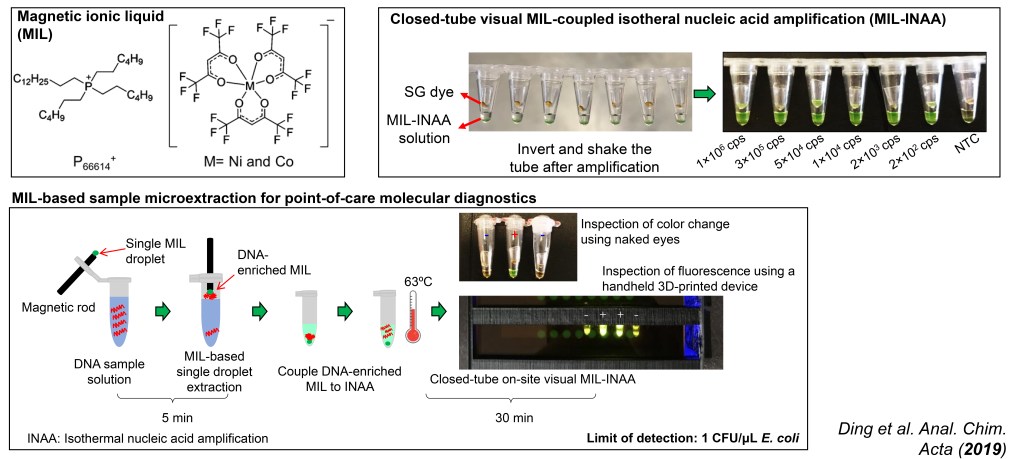
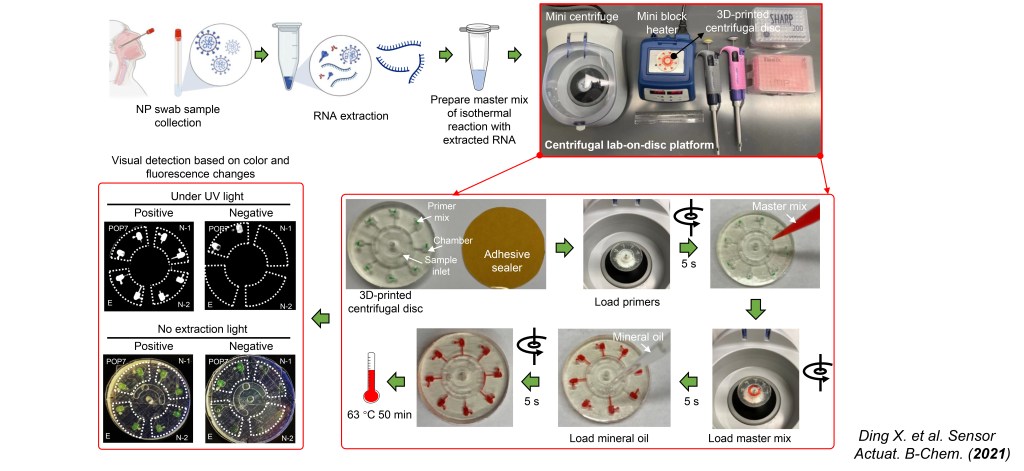
Xiong Ding, Kevin D. Clark, Marcelino Varona, Miranda N. Emaus, Jared L. Anderson*: Magnetic ionic liquid-enhanced isothermal nucleic acid amplification and its application to rapid visual DNA analysis. Analytica Chimica Acta, 2019, 1045, 132-140Xiong Ding, Ziyue Li, Changchun Liu. Monolithic, 3D-Printed Lab-on-Disc Platform for Multiplexed Molecular Detection of SARS-CoV-2. Sensors and Actuators B: Chemical. 2021, 351:130998. https://doi.org/10.1016/j.snb.2021.130998Xiong Ding, Ziyue Li, Lori Avery, Enrique Ballesteros, Rohit Makol, and Changchun Liu, pH-EVD: A pH Paper-based Extraction and Visual Detection System for Instrument-free SARS-CoV-2 Diagnostics, Advanced NanoBiomed Research, 2021. https://doi.org/10.1002/anbr.202100101




 Advanced Molecular Diagnostics & Devices Lab (AMDDL)